The Teaser-Price Trick — Why Your Hosting Bill Triples in Year Two
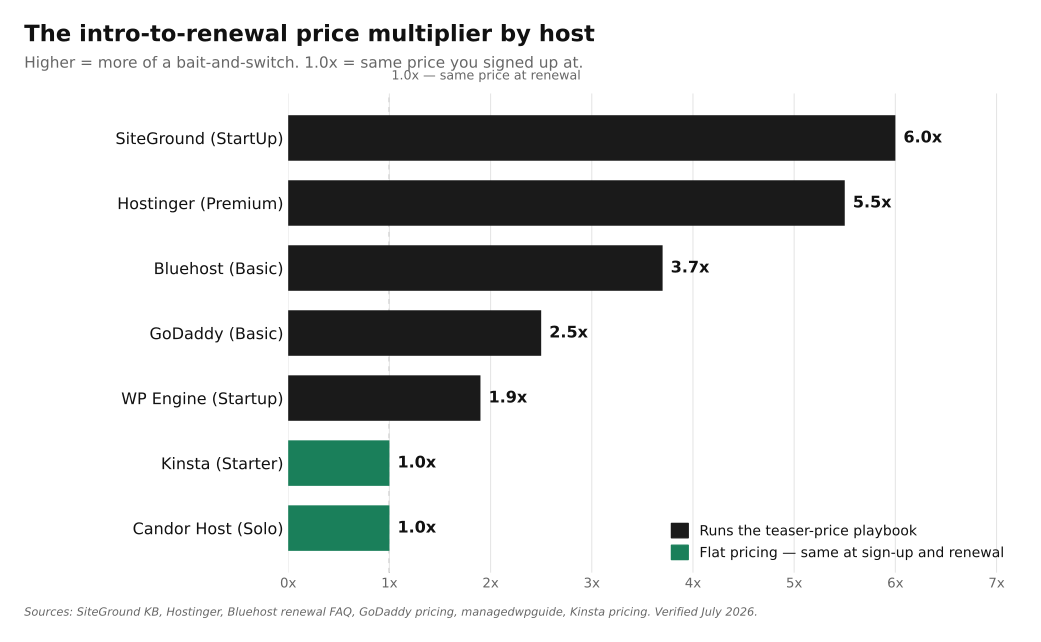
Key takeaways
- SiteGround StartUp: $2.99 → $17.99 (6.0x). 1
- SiteGround GrowBig: $4.99 → $29.99 (6.0x). 2
- Hostinger Premium: $1.99 → $10.99 (5.5x); requires a 48-month, $95.52 upfront prepay. 3
- Bluehost Basic: $2.95 → $10.99 (3.7x); daily backups cost an extra $35.88/year. 45
- GoDaddy Basic: $5.99 → $14.99 (2.5x); 7-day refund window on annual plans. 67
- WP Engine Startup: ~$13.33 promo → $25/mo (~1.9x), plus the ongoing WordPress.org platform-risk story. 89
- Kinsta Starter: $35 → $35. Flat. 10
- Candor Host Solo: $15 → $15. Studio: $35 → $35. Org: $75 → $75. Flat, forever.
Two of the eight numbers match at sign-up and renewal. Everyone else is running the playbook.
You sign up at $2.99. Two years later the invoice reads $431. You did not misread the pricing page. You read the part they showed you.
This piece is about the part they didn't.
The intro-to-renewal multiplier is the single most common pricing mechanic in shared and managed WordPress hosting. It is old, it is documented, it is legal, and it costs freelancers and small operators more real money than any other line item on the hosting comparison chart. The chart itself is where the trick lives.
Every dollar figure below has a source. Footnotes are at the bottom.
How does the teaser-price trick actually work?
Advertise a price low enough to win the click. Require a multi-year prepay to lock in that price. When the prepay term ends, auto-renew the account at three to six times the intro rate, on a credit card the customer entered thirty-six months ago and has probably forgotten about.
That is the mechanic. It has been the mechanic since Endurance International Group installed it across eighty acquired brands starting around 2010. 11
It survives because three things are true at once:
- The intro price is real. The renewal price is also real. Both are disclosed somewhere.
- The renewal disclosure is buried in a KB article, not on the pricing page. 1
- Most customers never actually check the renewal invoice. They set up their site, forget the login, and the card gets charged.
The customer who does check finds the money is already gone.
Which hosts run the teaser-price playbook?
Every price below was checked in June and July 2026. Every figure has a citation.
SiteGround
| Plan | Intro (first term) | Renewal | Multiplier |
|---|---|---|---|
| StartUp | $2.99/mo 1 | $17.99/mo 1 | 6.0x |
| GrowBig | $4.99/mo 2 | $29.99/mo 2 | 6.0x |
A GrowBig customer who signs up for the annual plan pays roughly $59.88 in year one and $359.88 in year two. That is not a rate increase. That is a Trustpilot quote: "Plan increases 600% after year 1." 12
Renewal rates are not shown on SiteGround's public pricing page. They live in a KB article titled "Current Rates for Shared Hosting Plans," which you have to know exists to find. 1
Hostinger
| Plan | Intro (with prepay) | Prepay term | Renewal | Multiplier |
|---|---|---|---|---|
| Premium | $1.99/mo 3 | 48 months, $95.52 upfront 3 | $10.99/mo 3 | 5.5x |
| Business | $2.99/mo 3 | 48 months 3 | $16.99/mo 3 | 5.7x |
The Hostinger version is more elegant. To get the $1.99 price advertised on the homepage, you write a check for four years upfront. When those four years are up, the account renews at $10.99/mo without further discussion. The $95.52 was never really $1.99/month — it was a $95.52 flat fee for four years followed by a full-price contract. On the Premium plan, that's weekly backups. Daily backups cost more. 13
Bluehost
| Plan | Intro (with prepay) | Renewal | Multiplier |
|---|---|---|---|
| Basic | $2.95/mo, 36-month prepay ($143.64) 4 | $10.99/mo 4 | 3.7x |
| Choice Plus | ~$5.45/mo intro (~$65 first year) 14 | $263.88/yr 14 | ~4.4x |
Bluehost's teaser is milder than SiteGround's or Hostinger's, but the base plan does not include daily backups. Daily backups require CodeGuard Basic, which adds $35.88/year on top of the renewal rate. 5 Managed migration is a separate line item at $149.99. 15 The renewal multiplier is the headline; the add-on stack is the follow-up.
WebHostMost's 2026 Bluehost review documents cases where the effective year-two total was 361% higher than the customer expected, and at least one renewal invoice reaching $755. 14
GoDaddy Managed WordPress
GoDaddy sits at the milder end of the multiplier chart but compensates with a shorter refund window: 7 days on annual Websites + Marketing plans, 48 hours on monthly. 7 The standard 30-day industry window does not apply to the plans they promote hardest. If the auto-renew charge posts and you notice it a week later, the money is theirs.
WP Engine
| Plan | Intro (annual) | Renewal | Multiplier |
|---|---|---|---|
| Essential Startup | ~$13.33/mo effective (4 months free promo) 8 | $25/mo annual 8 | ~1.9x |
WP Engine does not run a 5–6x spike. Their intro-vs-renewal delta is a promotional discount that ends, not a bait-and-switch. Fair pricing, with a caveat: the September 2024 dispute with WordPress.org cut ~200,000 WP Engine sites off from plugin and theme updates for over a week until a California district court intervened. Automattic filed counterclaims in October 2025. Litigation is still open. 916 That's a different category of risk, but it belongs on the same page.
Which managed WordPress hosts have honest, flat pricing?
There are exactly two.
Kinsta. Starter plan is $35/mo at sign-up and $35/mo at renewal. Multiplier: 1.0x. 10 Kinsta's own reviewers put it plainly: "Kinsta keeps its renewal prices the same — no surprise fees or price hikes." 10 They are the reference point for what honest renewal pricing looks like at the premium end of the managed-WordPress market. They also do free migrations on every plan, including Starter. 17
Candor Host. Solo plan is $15/mo at sign-up and $15/mo at renewal. Studio is $35 for five sites, Org is $75 for fifteen — all flat forever. The rate you sign up at is the rate you keep. We publish server density (150 sites per box, live count on the homepage) and we do the migration for free on every plan. If we ever raise a published price, existing customers keep theirs.
Kinsta and Candor Host are not the same product. Kinsta runs on Google Cloud Platform with LXD containers. Candor Host runs on our own metal in Vint Hill, Virginia, with per-site cgroups isolation. Kinsta's Starter is one site for $35. Candor Studio is five sites for $35. Both companies do the pricing part the same way: what you see is what you renew at.
The rest of the industry does not.
How did teaser-then-renew pricing become the industry standard?
The intro-then-renewal-hike model is not an accident of the market. It has a paper trail.
Endurance International Group (EIG) acquired Bluehost in 2010 and HostGator in July 2012 for $299.8 million. 11 Over the following decade, EIG rolled up roughly eighty hosting brands — HostGator, Bluehost, iPage, FatCow, JustHost, HostMonster, A Small Orange, Site5, Arvixe, and dozens more — and installed a common pricing chassis across all of them. 11
The internal strategy documents the trade press was able to reconstruct classified the acquired brands as "non-strategic," with a stated plan to "raise prices, streamline operations, and expect a higher than normal level of churn." 11 That last phrase is the important one. The model assumes customers will leave. It just needs them to stay one billing term longer than they meant to.
EIG rebranded to Newfold Digital in 2021 after merging with Web.com. 11 The brands, and the pricing model, persist. SiteGround adopted a comparable model in the following years and pushed the multiplier further — from EIG's 3–4x range up to 6x on the flagship plan. 12 Hostinger and GoDaddy landed on the same mechanic with different prepay terms.
A quote worth pulling from RankThatHost's 2026 EIG explainer:
"The introductory rate is a customer acquisition cost subsidized by existing customers paying full price, while the renewal rate is the actual price of the service." 11
Put another way: the price you renew at is the real price. Everything before it is marketing.
How can you spot bait-and-switch hosting before you sign up?
Screenshot this. Five checks, in order. Any host that fails two or more is running the playbook.
1. Look for a renewal price on the pricing page itself. Not in a KB article. Not in a footnote. Not "starting at." An actual dollar figure next to the intro price. If you have to search the help center to find it, that is the answer.
2. Check the required prepay term. The advertised monthly price almost always requires paying 12, 36, or 48 months upfront. If the monthly-billed rate is 40–60% higher than the "monthly" price on the homepage, the homepage price is a prepay-only discount, not a monthly rate.
3. Read the refund policy for the specific plan you're buying. Especially for managed WordPress and "Websites + Marketing" bundles. Some hosts publish a 30-day money-back guarantee at the top of the page but exclude the plan you're actually looking at. 7
4. Search for the phrase "renewal price" plus the host name on Reddit or Trustpilot. If the top five results all describe the same year-two shock in the same terms, you have your answer. This takes 45 seconds and is the single highest-leverage check on the list.
5. Ask whether daily backups are included on the plan tier you're buying. Not on some higher tier. On the plan you're clicking Buy on. If the answer is "you can add CodeGuard for $2.99/month billed annually" or "daily backups are available on Business and above," daily backups are not included. 135
You do not need to be a hosting expert to run these checks. You need thirty seconds and the willingness to look at the receipt before you sign.
What does honest hosting pricing actually look like?
If a host is willing to price honestly, the pricing page shows it. Two features, both boring:
- One number per plan. Sign-up price and renewal price are the same, so there is only one number to publish. When you see a single unbadged number with no fine print, believe it. When you see "$2.99*" with an asterisk, follow the asterisk.
- The renewal price appears in the checkout confirmation before you enter a card. Not after. If the renewal rate is disclosed only in a KB article or in the terms of service you agreed to on page three, that is a design decision, not an oversight.
The reason most hosts don't do this is not that flat pricing doesn't work. Kinsta runs a nine-figure business on it. 10 The reason is that the intro-to-renewal delta is where the margin lives. Charging $2.99 to win the click and $17.99 to keep the customer is more profitable than charging $10 the whole way through. It works because most customers don't check.
That is a business decision. It is not a law of physics. Two hosts have made a different decision. There is room for a third.
A note on tone
This article names names. That is deliberate. Naming names is a category of writing that has largely disappeared from the hosting review internet, mostly because the affiliate-commission economics of that internet reward vague warmth toward every product on the comparison chart. If a hosting review sounds like a friend telling you which one to buy, it is almost certainly written by someone who gets $150 when you click through.
We do not run an affiliate program. We do not pay for reviews. We do not have a partnership with any of the hosts named above. The prices in this piece were checked against current-year sources in July 2026. If anything above is wrong, we will fix it and post-date the correction at the bottom.
If you'd rather just look at what our own pricing page says
That's here. One number per plan. Same number at renewal.
Sources
Pricing verified July 2026. If a number changes, we will update this article and note the change here. Candor Host is a product of R Software & Consulting LLC. We do not participate in any hosting affiliate program.
- SiteGround, "Current Rates for Shared Hosting Plans" KB article, verified July 2026. https://www.siteground.com/kb/current-rates-shared-hosting-plans/ ↩
- Cybernews, "SiteGround Review: Pricing," verified July 2026. https://cybernews.com/best-web-hosting/siteground-review/pricing/ ↩
- Cybernews, "Hostinger Review: Pricing," verified July 2026. https://cybernews.com/best-web-hosting/hostinger-review/pricing/ ↩
- Bluehost, "Renewal Price FAQ." https://www.bluehost.com/help/article/renewal-price-faq ↩
- Bluehost, "CodeGuard" help article, pricing verified July 2026. https://www.bluehost.com/help/article/codeguard ↩
- Cybernews, "GoDaddy Review: Pricing," verified July 2026. https://cybernews.com/best-web-hosting/godaddy-review/pricing/ ↩
- GoDaddy, "Refund Policy," legal agreement. https://www.godaddy.com/legal/agreements/refund-policy ↩
- managedwpguide, "WP Engine Pricing 2026." https://managedwpguide.com/wp-engine-pricing/ ↩
- TechCrunch, "Court orders Mullenweg and Automattic to restore WP Engine's access to WordPress.org," December 10, 2024. https://techcrunch.com/2024/12/10/court-orders-mullenweg-and-automattic-to-restore-wp-engines-access-to-wordpress-org/ ↩
- NorthiScale, "Kinsta Pricing Guide 2026," including flat-pricing confirmation. https://northiscale.com/guides/kinsta-pricing ↩
- RankThatHost, "What Is EIG? A Beginner's Guide," including internal strategy documentation. https://rankthathost.com/beginners-guide/what-is-eig/ ↩
- OnlineMediaMasters, "SiteGround WordPress Hosting Review," quoting Trustpilot user complaint. https://onlinemediamasters.com/siteground-wordpress-hosting-review/ ↩
- Hostinger Support, "How to Activate Daily Backups in Hostinger." https://www.hostinger.com/support/1665153-how-to-activate-daily-backups-in-hostinger/ ↩
- WebHostMost, "Bluehost Review 2026," including documented renewal-invoice cases. https://blog.webhostmost.com/bluehost-review-2026/ ↩
- Bluehost Professional Services, migration pricing page. https://www.bluehost.com/professional-services/ ↩
- TechCrunch, "Automattic files counterclaims against WP Engine in WordPress lawsuit alleging trademark misuse," October 24, 2025. https://techcrunch.com/2025/10/24/automattic-files-counterclaims-against-wp-engine-in-wordpress-lawsuit-alleging-trademark-misuse/ ↩
- Kinsta, "Unlimited Free Migrations" changelog. https://kinsta.com/changelog/unlimited-free-migrations/ ↩